



What Are Signs of a Blocked Drain?
Slow drainage, gurgling pipes, and foul smells are rarely minor inconveniences. Here is what those warning signals really mean, and when to call a professional.
Sandton on a summer afternoon brings a particular kind of certainty: the sky darkens fast, the rain arrives hard, and within minutes the stormwater channels along Rivonia Road and West Street are running full. Most residents give barely a thought to what is happening underground. The drains cope. They always have. Until the day they do not, and a slow gurgle from the bathroom basin is the first sign that something has gone wrong. Recognising the signs of a blocked drain early is what separates a quick fix from a costly emergency.
South Africa’s ageing municipal sewer infrastructure is under sustained pressure. According to The South African, more than 50 per cent of the country’s water infrastructure is classified as being in poor or very poor condition, with Johannesburg’s dense commercial and residential mix placing extraordinary strain on both public and private drainage networks. The purpose of this article is straightforward: to help Sandton homeowners and property managers identify the early warning signs of a blocked drain before a manageable problem becomes a structural one.
Why Sandton’s Conditions Make Blocked Drains More Likely
Sandton sits within the City of Johannesburg Metropolitan Municipality and carries a drainage burden that most Gauteng suburbs do not. The suburb’s dense mix of high-rise commercial towers, large-footprint residential estates, and ageing spigot-and-socket clay pipes means that the underground network is simultaneously old and overloaded. The Johannesburg Roads Agency has recorded repeated stormwater flooding events along key Sandton arterials, particularly during the summer thunderstorm season that runs from October through to March.
Compounding this is the root system activity beneath Sandton’s established trees. Jacarandas and eucalyptus species, common throughout the area’s leafy streets and private gardens, are well-documented for sending roots into hairline pipe fractures. The South African Institute of Plumbing (SAIP) notes that tree root intrusion is one of the leading causes of repeat blockages in established Johannesburg suburbs. When a root enters a vitrified clay pipe, it does not simply plug the flow: it continues to expand, fracturing the pipe from within. What begins as a partial blockage becomes a collapsed line.
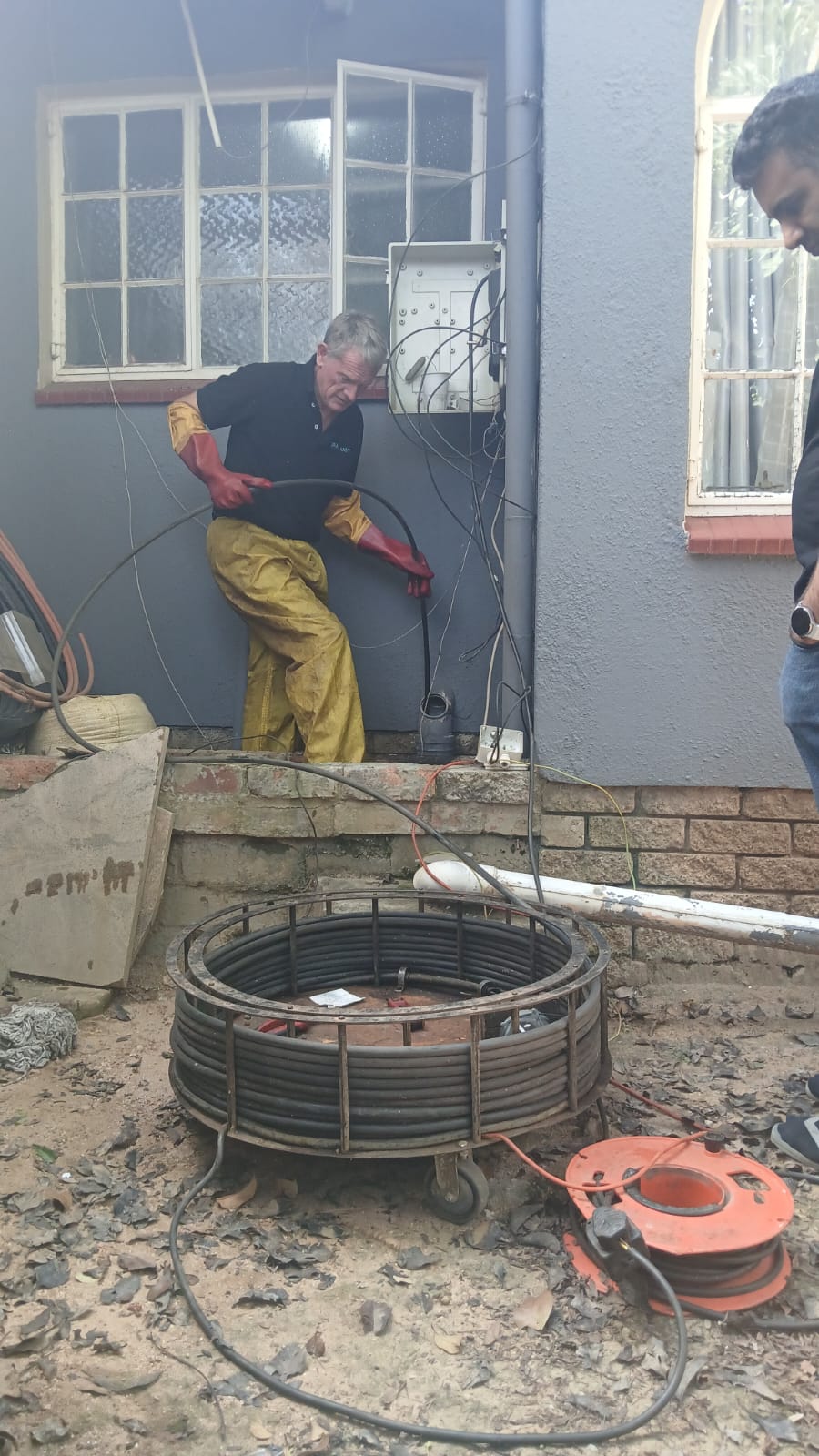
Standing water and slow drainage are among the earliest visible signs of a developing blockage.
Six Signs of a Blocked Drain You Should Never Ignore
Most blockages give clear warnings well before they cause serious damage. The problem is that these signals tend to appear gradually, making it easy to dismiss them as minor quirks. None of them are.
Water that lingers in the sink, bath, or shower after use is the most common first indicator. A partial obstruction is already restricting flow.
Bubbling or gurgling from pipes occurs when trapped air is forced past an obstruction as water tries to pass. The sound typically appears after flushing or draining.
A persistent sour or sewage smell rising from a drain means organic matter, food scraps, or waste is trapped and decomposing inside the pipe.
If flushing the toilet causes water to rise in the shower basin, or using the kitchen tap fills the bathroom basin, the main sewer line is likely blocked.
A toilet that fills higher than normal, flushes weakly, or shows bouncing water levels points to a venting or sewer line restriction that needs immediate attention.
Standing water around stormwater grids or an overflowing manhole in the yard are strong indicators of a deep-line blockage, often beyond the property boundary.
Note on multiple signs appearing together: When two or more of these symptoms occur at the same time across different fixtures, the blockage is almost certainly in the main sewer line rather than a single branch pipe. This requires a CCTV pipe inspection to locate precisely before any clearing work begins.
Choosing the Right Drain Unblocking Method
Once a blockage is confirmed, the next question is how to clear it. Two methods dominate residential and commercial drain unblocking in Sandton: mechanical rodding and high-pressure water jetting. Each has its place, and choosing the wrong method for the situation can cause more harm than the blockage itself.
Mechanical Rodding (Drain Snaking)
Drain rodding uses a flexible steel cable with an auger tip, fed into the pipe to break apart or retrieve the obstruction. It is the traditional approach and remains effective for simple, localised blockages close to the drain access point.
Pros
- Fast to deploy on accessible blockages
- Lower cost for simple jobs
- Minimal water usage
- Suitable for soft obstructions (hair, soap buildup)
Cons
- Does not clean pipe walls
- Cannot dislodge compacted grease or roots effectively
- Risk of cable damage to aged clay pipes
- Does not diagnose underlying pipe condition
High-Pressure Water Jetting (Hydro Jetting)
Hydro jetting uses a specialised nozzle to deliver water at pressures between 2,000 and 4,000 PSI through the pipe, cutting through grease, root intrusions, and compacted debris while simultaneously cleaning the pipe wall. It is the preferred method for recurring blockages and commercial lines.
Pros
- Clears the full bore of the pipe
- Effective against root intrusions and grease
- Cleans pipe walls, reducing reblockage risk
- Preferred for commercial and high-use lines
Cons
- Higher cost than rodding
- Requires professional equipment and training
- Not suitable for severely damaged or collapsed pipes
| Feature | Mechanical Rodding | Hydro Jetting |
|---|---|---|
| Best for | Simple, localised blockages | Recurring blockages, grease, roots |
| Pipe wall cleaning | No | Yes |
| Root intrusion | Limited | Effective |
| Risk to aged pipes | Moderate | Low (with inspection first) |
| Relative cost | Lower | Higher |
| Recommended follow-up | Monitor | CCTV inspection |

High-pressure water jetting clears the full bore of the pipe and removes buildup on the pipe wall, not just the obstruction itself.
How Often Should Drains Be Serviced in Sandton?
Residential drains in a typical Sandton home benefit from a professional inspection and flush every 12 to 18 months, ideally before the summer storm season begins in October. Commercial properties, restaurants, and sectional title complexes with shared sewer lines should schedule a drain and sewer cleaning service at least twice per year. Neglecting this cycle does not simply mean a higher chance of a blockage: it means a higher chance of a pipe collapse, raw sewage backflow, and the associated structural and hygiene damage to the property.
A once-yearly professional drain cleaning service offers several measurable benefits over the reactive approach of waiting for a problem to appear:
- Early detection of pipe defects. A CCTV video pipe inspection during a routine service reveals hairline cracks, root intrusion, and offset joints before they escalate.
- Removal of grease and scale buildup. Kitchen lines, particularly in properties with a high cooking frequency, accumulate fats and oils that progressive water jetting removes entirely.
- Root inhibitor treatment. Applied after clearing, root inhibitor slows regrowth into the pipe for up to 12 months.
- Documented pipe condition record. A written inspection report establishes a baseline, useful for insurance claims, property sales, and sectional title body corporate compliance.
Why Professional Drain Cleaning Beats a DIY Fix Every Time
Shop-bought chemical drain cleaners and hand-operated plungers address the symptom, not the source. A sodium hydroxide product dissolves hair and soap, but it does nothing to a root intrusion or a grease plug 10 metres down the line, and repeated use on vitrified clay pipes can accelerate corrosion of already-ageing joints. According to the Wikipedia overview of drain cleaning chemistry, many chemical solutions simply push blockage material further into the system rather than removing it. The blockage returns, often sooner and worse than before.
Sandton’s property values and rental income exposure make this a financial consideration as much as a practical one. A sewage backflow event in a R5 million home or a multi-tenanted sectional title block carries liability and remediation costs that dwarf the price of a professional blocked drain service. When selecting a drain unblocking service in the area, there are specific things to insist on.
- A written quotation before any work begins, with a clear breakdown of the method to be used.
- CCTV inspection capability, so the technician can confirm the blockage location and pipe condition before and after clearing.
- A workmanship guarantee on the clearing service, covering the job for a defined period after completion.
The Vent Stack: The Overlooked Cause of Persistent Gurgling
Many Sandton homeowners chase a gurgling drain through multiple service calls without resolution, because the cause sits not in the drain line itself but in the vent stack above the roof. Drain and sewer systems are designed as a balanced air-and-water circuit: water flows down, air flows up through a vertical vent pipe that exits through the roof. When that vent becomes blocked by debris, bird nests, or a poorly installed roof modification, negative pressure builds in the drain system and air is forced back through the water seals in traps and basins. The result is the characteristic gurgling sound that most people assume indicates a blocked pipe. A Sandton property with large established trees is particularly exposed to vent stack blockages from leaf debris and nesting material. Any professional drain technician worth consulting will check vent stack access points as part of a full plumbing services assessment, alongside the drain lines themselves.
The signs of a blocked drain are rarely subtle once you know what to look for: slow drainage, gurgling sounds, foul odours, and water backing up across fixtures are all telling you the same thing at increasing levels of urgency. The comparison between mechanical rodding and high-pressure water jetting is not about cost alone; it is about choosing the method that genuinely resolves the underlying issue rather than temporarily clearing a symptom. And a scheduled annual inspection, rather than an emergency call, remains the most reliable way to protect a Sandton property from the real cost of a sewer failure.
Sandton’s summer storms are not going to slow down, and neither is the root growth beneath its tree-lined streets. A drain that is performing poorly in June will be failing entirely by November when the peak storm season arrives and every pipe in the system is working at capacity.
Do not wait until a slow drain becomes a sewage emergency. Drain Masters serves Sandton, Johannesburg, and surrounding Gauteng suburbs with same-day response and CCTV-confirmed results.