



Case Study — Drain Root Removal · Vorna Valley, Midrand
Unblock Drain Root Removal in Vorna Valley, Midrand
Mature trees and ageing clay pipes are a combination that quietly destroys residential sewer lines. Here is what happened when roots took over in Vorna Valley, and how the damage was reversed.
It starts as a slow drain. Then a gurgle from the toilet when the bath empties. Then, one ordinary Tuesday morning, a sewage backup through the lowest floor fitting in the house. By the time most Vorna Valley homeowners call a plumber, the tree roots responsible have been growing inside their sewer pipes for months, possibly years, feeding on the warm moisture and quietly filling the bore until nothing can pass.
Tree root intrusion is one of the most common and destructive causes of residential sewer failure in established Highveld suburbs, yet it is consistently underestimated until a crisis forces the issue. According to the Water Research Commission of South Africa, root-related pipe damage contributes significantly to private-side sewer failures in older residential areas, and the costs of late-stage intervention far exceed those of early detection and removal. This article documents a drain root removal job completed by Drain Masters in Vorna Valley, Midrand, explains why the suburb is particularly vulnerable, and sets out what every homeowner here should understand before their next blockage becomes a structural repair bill.
Why Vorna Valley Is Especially Vulnerable to Root Intrusion
Vorna Valley is a well-established residential suburb in Midrand, developed primarily from the 1980s onwards. That era of construction corresponds directly with the widespread use of vitrified clay and early PVC pipe in residential drainage. Clay pipe, in particular, has a notable vulnerability: its joints rely on mortar or rubber compression seals that degrade over decades, opening small gaps that tree roots are extraordinarily adept at finding. A root does not break in; it threads through a hairline crack, drawn by the warm, nutrient-rich moisture inside the pipe, and then expands as it grows until the joint fails entirely.
The suburb’s generous tree canopy makes this worse. Vorna Valley streets and gardens feature large indigenous and exotic specimens, many of them now 30 to 40 years old with root systems extending well beyond their visible canopy. As noted by Midrand municipality arborists and consistent with findings reported by IOPSA (the Institute of Plumbing South Africa), the species most commonly responsible for sewer pipe intrusion in Gauteng include Tipuana tipu, Jacaranda mimosifolia and various fig varieties. All three are well represented in Vorna Valley gardens. Combine mature tree root systems with 40-year-old clay pipe joints and a prolonged dry spell, and the conditions for a severe root blockage are almost inevitable.
The full story: before & after root removal
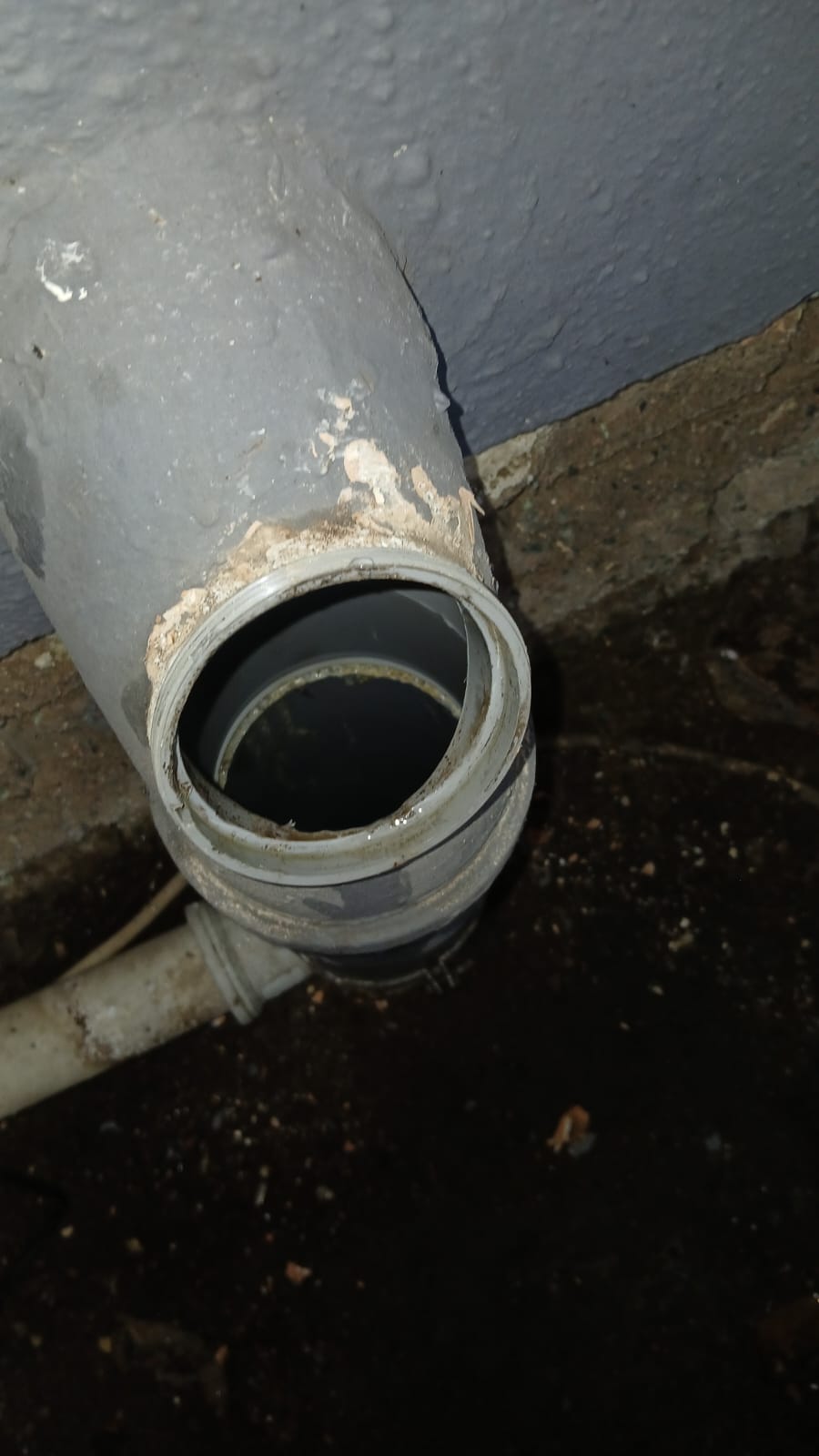
Root mass discovered during CCTV inspection: the pipe bore is almost entirely blocked by a dense tangle of fibrous roots that have been growing through a failed joint for an estimated 12 to 18 months.
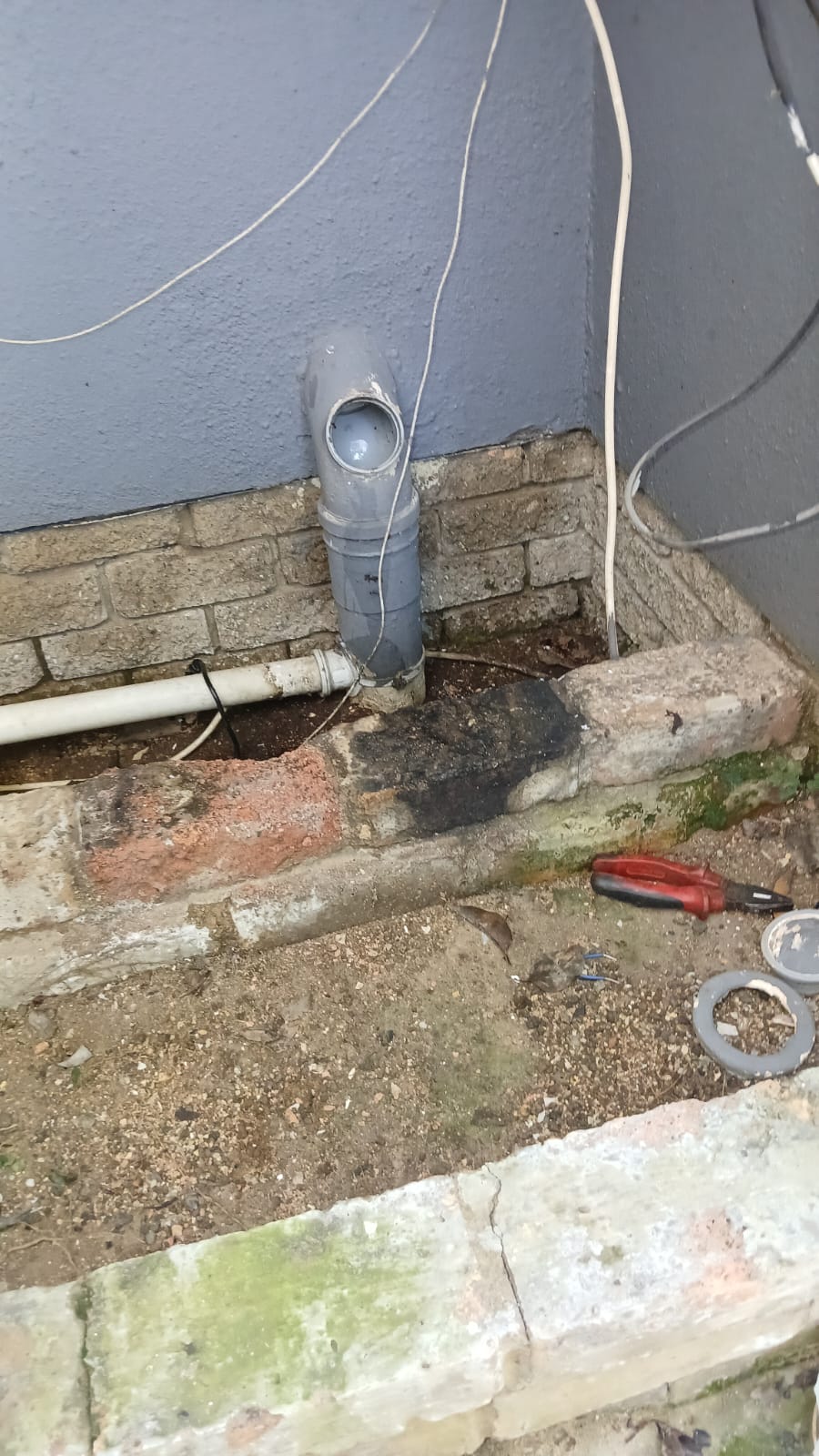
A closer view of the intrusion point: roots have entered at a failed mortar joint and expanded radially, forming a mesh that traps solids and accelerates the blockage cycle with every flush.
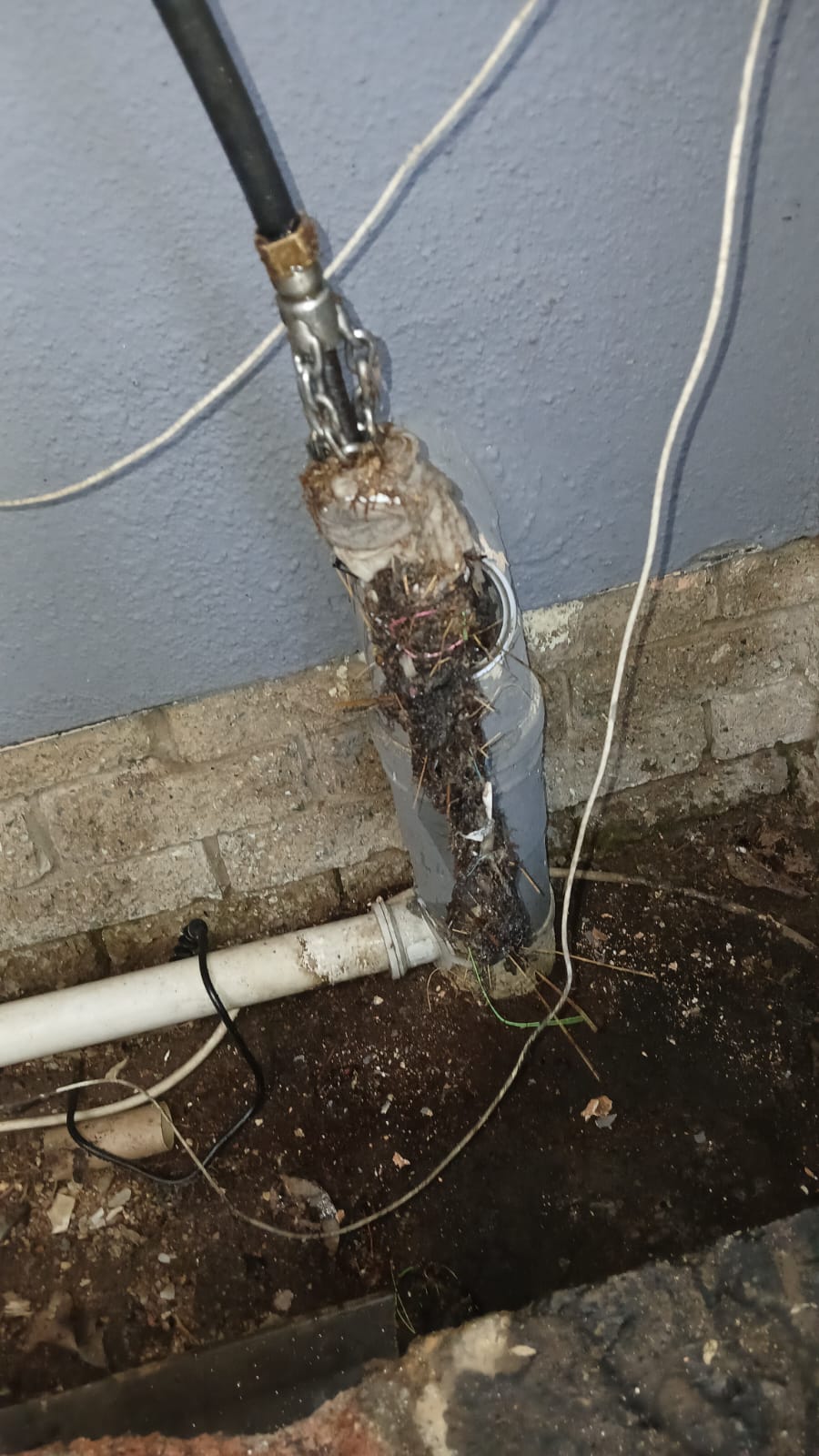
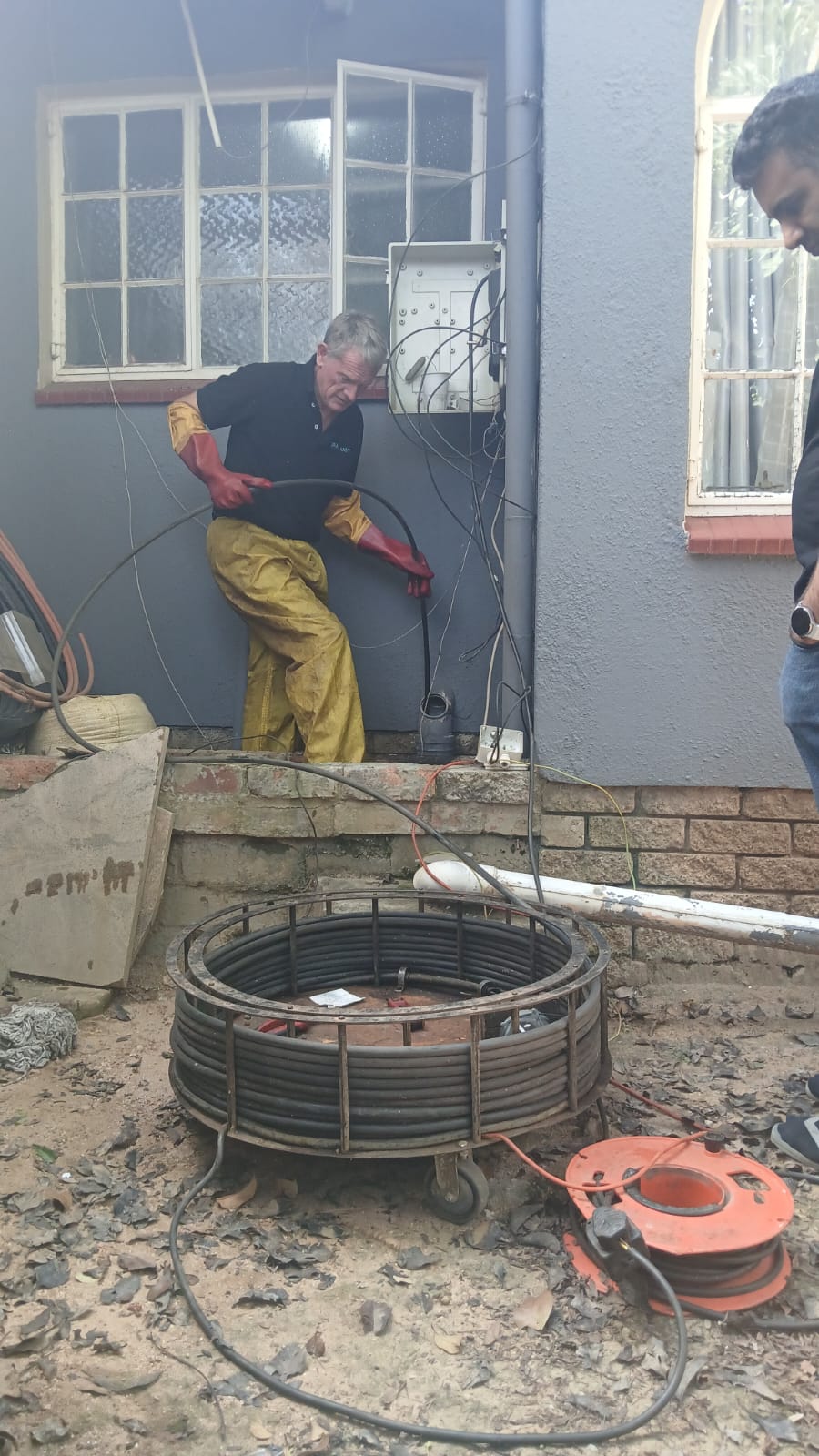
High-pressure water jetting cuts through the root mass and flushes dislodged material downstream. The root-cutting nozzle works in both directions to clear the full affected section of pipe.
Full bore restored. A post-clearance CCTV pass confirmed the pipe clear from the access point to the municipal connection, with the entry joint flagged for future monitoring or repair.
Choosing the Right Removal Method: Mechanical Rodding vs High-Pressure Jetting
Not all root blockages are the same, and the method of removal should match the severity of the intrusion. The two principal approaches used by professional contractors each have distinct strengths. Understanding the difference helps homeowners ask better questions and avoid being sold an inappropriate fix for their specific situation. Both fall under the broader discipline of drain cleaning, but they operate on very different principles.
Option A: Mechanical Drain Rodding
Rodding involves feeding a flexible steel rod through the pipe, using the mechanical action of the rod head to break up and dislodge the root mass. It is the traditional method and remains effective for lighter, early-stage intrusions.
Pros
- Cost-effective for early-stage or low-density root intrusion
- Widely available; most drain contractors carry rodding equipment
- Minimal setup time for straightforward access points
- Effective for soft or juvenile root growth
Cons
- Cannot fully clear a dense or mature root mass
- Leaves root fibres adhered to the pipe wall, encouraging re-growth
- May compact rather than remove a heavy blockage
- No downstream flushing; debris can re-lodge further along the pipe
Option B: High-Pressure Water Jetting with Root-Cutting Nozzle
A specialist water jet drain cleaning service, fitted with a root-cutting nozzle, uses high-pressure water to slice through root mass and flush the pipe clean in a single operation. For established root intrusions of the kind found in Vorna Valley, it is the method of choice.
Pros
- Cuts through dense, mature root masses effectively
- Flushes the full pipe length clear of loose debris
- Leaves the pipe wall clean, slowing the rate of re-growth
- Can be combined with CCTV inspection in the same visit
Cons
- Higher cost than basic rodding
- Requires specialist nozzle equipment and a trained operator
- Not necessary for light, early-stage root growth
- Does not permanently prevent re-entry at the failed joint
| Feature | Mechanical Rodding | High-Pressure Jetting |
|---|---|---|
| Best for | Light, early-stage root intrusion | Dense or mature root blockages |
| Root mass removal | Partial; fibres remain on wall | Full clearance in most cases |
| Pipe wall cleanliness | Residual fibres present | Wall cleared to pipe surface |
| Downstream flushing | No | Yes |
| Typical cost | Lower | Moderate to higher |
| Re-blockage risk | Higher; root fibres encourage regrowth | Lower; cleaner pipe wall slows regrowth |
On the Vorna Valley job, the density of the root mass ruled out rodding as a primary method. The team used high-pressure jetting with a root-cutting nozzle to clear the full affected section, followed immediately by a CCTV video pipe inspection to confirm complete clearance and document the failed joint for the homeowner’s records.
Preventing the Next Blockage: The Maintenance Argument
Tree roots grow back. This is the uncomfortable truth that separates drain root removal from a permanent fix. Once a root has found and entered a pipe joint, that entry point remains a vulnerability regardless of how well the initial clearance is executed. The only permanent solution is pipe repair or relining at the affected joint; however, for homeowners who are not yet ready for that investment, a disciplined inspection and cleaning programme significantly extends the time between crises and gives early warning before a minor intrusion becomes a structural failure.
IOPSA guidelines recommend that any residential drain with a confirmed history of root intrusion be inspected professionally every twelve months at a minimum, with high-risk properties in tree-dense suburbs such as Vorna Valley benefiting from a six-month review cycle. The cost of an annual CCTV inspection is a fraction of the cost of an emergency root clearance, let alone a pipe replacement. A proactive programme built around these principles keeps the system manageable:
- Annual CCTV inspection: Book a camera survey every twelve months to monitor root regrowth at known entry points. Early detection means a faster, cheaper clearance.
- Root inhibitor treatment: Copper sulphate or foaming root inhibitor, applied after each professional clearance, slows re-entry without harming the tree above ground. Ask your contractor about this at the time of service.
- Pipe relining at the entry joint: If the same joint fails repeatedly, a no-dig pipe reline seals the entry point permanently without excavation. This is the most cost-effective long-term fix for a single vulnerable section.
- Tree management: In severe cases, consulting an arborist about root barrier installation or species replacement adjacent to the sewer line is a worthwhile long-term measure.
Why Professional Drain Root Removal Matters in Vorna Valley
A significant proportion of root blockage callouts in established suburbs like Vorna Valley are preceded by at least one failed DIY attempt. The appeal is obvious: a hardware store drain rod costs a few hundred rand and the problem seems straightforward. The reality is that mechanical rodding without the right nozzle, applied to a mature root mass, frequently compacts the blockage rather than clearing it, pushing the material further down the pipe and making the professional job harder and more expensive. There is also a structural risk: forcing a steel rod through a root mass in a deteriorating clay pipe can crack the pipe wall, converting a root blockage into a pipe collapse.
Professional drain and sewer cleaning for root intrusion requires specialist nozzle equipment, a pressurised water supply capable of cutting through fibrous root material, and the judgement to know when mechanical intervention is needed alongside hydraulic clearing. Equally important is the post-service inspection. A reputable contractor will not sign off a root removal job without confirming that the full pipe bore is clear, the removed material has been flushed to an accessible point for extraction, and the homeowner has a documented record of the entry point location for future reference. When choosing a contractor in Vorna Valley, look for the following:
- CCTV survey included or offered: Any contractor clearing roots without a camera does not know what they have left behind.
- Written service report with entry point location: You need to know exactly where the failed joint sits so you can make an informed decision about pipe repair or relining.
- Root inhibitor recommendation: A professional will discuss post-clearance treatment options rather than leaving re-growth to chance.
Red flags to avoid: contractors who clear the blockage and leave without any form of post-service confirmation, verbal-only quotes with no written follow-up, and any suggestion that chemical treatment alone can resolve an established root intrusion.
The Detail Most Homeowners Overlook: The Joint, Not the Root
Tree root removal clears the symptom. The failed pipe joint is the cause, and until it is addressed, the symptom will return. In the context of residential plumbing in a suburb like Vorna Valley, this distinction matters enormously. A cleared pipe with an open joint is not a repaired pipe; it is a cleared pipe that roots will re-enter within one to three growing seasons, depending on species and soil moisture. The Vorna Valley job documented here identified the entry joint precisely via CCTV survey, giving the homeowner a clear decision to make: monitor and re-clear on a scheduled basis, or invest in a targeted no-dig pipe reline to seal the entry point permanently. That decision, informed by documented evidence rather than guesswork, is what separates a professional drain cleaning service from a temporary fix. If you are managing a root-affected sewer line in an established suburb, insist on knowing exactly where the entry point is and what your long-term options are. Anything less is a solution that is counting down to its own expiry date.
Frequently Asked Questions: Drain Root Removal in Midrand
How do I know if tree roots are causing my blocked drain?
The most reliable indicator is a slow-developing blockage in a property with mature trees, particularly if the problem recurs after each clearing. Gurgling sounds from toilets when baths or basins drain, and sewage smells from outdoor inspection chambers, are consistent with root intrusion. The only way to confirm it is with a CCTV pipe inspection: a camera will show the root mass and its exact location within a few minutes.
Will the roots grow back after removal?
Yes, if the entry joint is not repaired or relined. Roots are persistent; once a route into the pipe is established, they will re-enter from the same point within one to three growing seasons in typical Highveld conditions. Root inhibitor treatment after clearance slows this, but the only permanent fix is sealing the joint through pipe relining or spot repair. Your contractor should discuss both options after the initial clearance.
Is this covered by home insurance?
Coverage varies significantly between policies and insurers. Some policies cover sudden and unforeseen drain damage but exclude gradual deterioration, which is typically how root intrusion is classified. It is worth submitting a claim with photographic and CCTV evidence regardless; having a documented record from a professional service report strengthens any claim considerably. Drain Masters provides written documentation on every job that can be submitted directly to insurers.
How long does a drain root removal take?
For a single-section root blockage accessible from a standard inspection chamber, a professional team will typically complete the clearance and post-service CCTV survey within two to three hours. More extensive intrusion affecting multiple sections of pipework may take longer. Most Vorna Valley homeowners can have the job completed within a single morning or afternoon without major disruption to the property.
Can Drain Masters help with related drainage problems in Midrand?
Yes. Alongside drain root removal, Drain Masters provides blocked drain services, drain unblocking, grease trap cleaning and full drain and sewer cleaning across Midrand and surrounding areas. Contact the team directly to discuss your specific situation.
Drain root removal is one of those jobs that feels like a one-off event but rarely is. The Vorna Valley job documented here is a clear illustration of how root intrusion develops: slowly, invisibly, over months or years, until a mature tree root system finally fills the pipe bore and forces the issue. The cleared drain is only the beginning of the management process. Understanding where the entry joint sits, monitoring its condition, and making an informed decision about pipe relining are the steps that separate a homeowner who solves the problem from one who simply delays its return.
Midrand is entering its dry winter months, and the water stress that drives tree roots deeper and wider in search of moisture is already building. That process does not pause because your drain is currently flowing. If your property has mature trees within ten metres of a sewer line, and particularly if you have had a slow or blocked drain in the past two years, a camera inspection now will tell you what is growing in the pipe before it tells you itself.
Do you have mature trees near your sewer line in Vorna Valley?
Do not wait for a backup to find out what is growing inside your pipes. Book a CCTV inspection or request a drain root removal quote from Drain Masters today.